 By Jared White
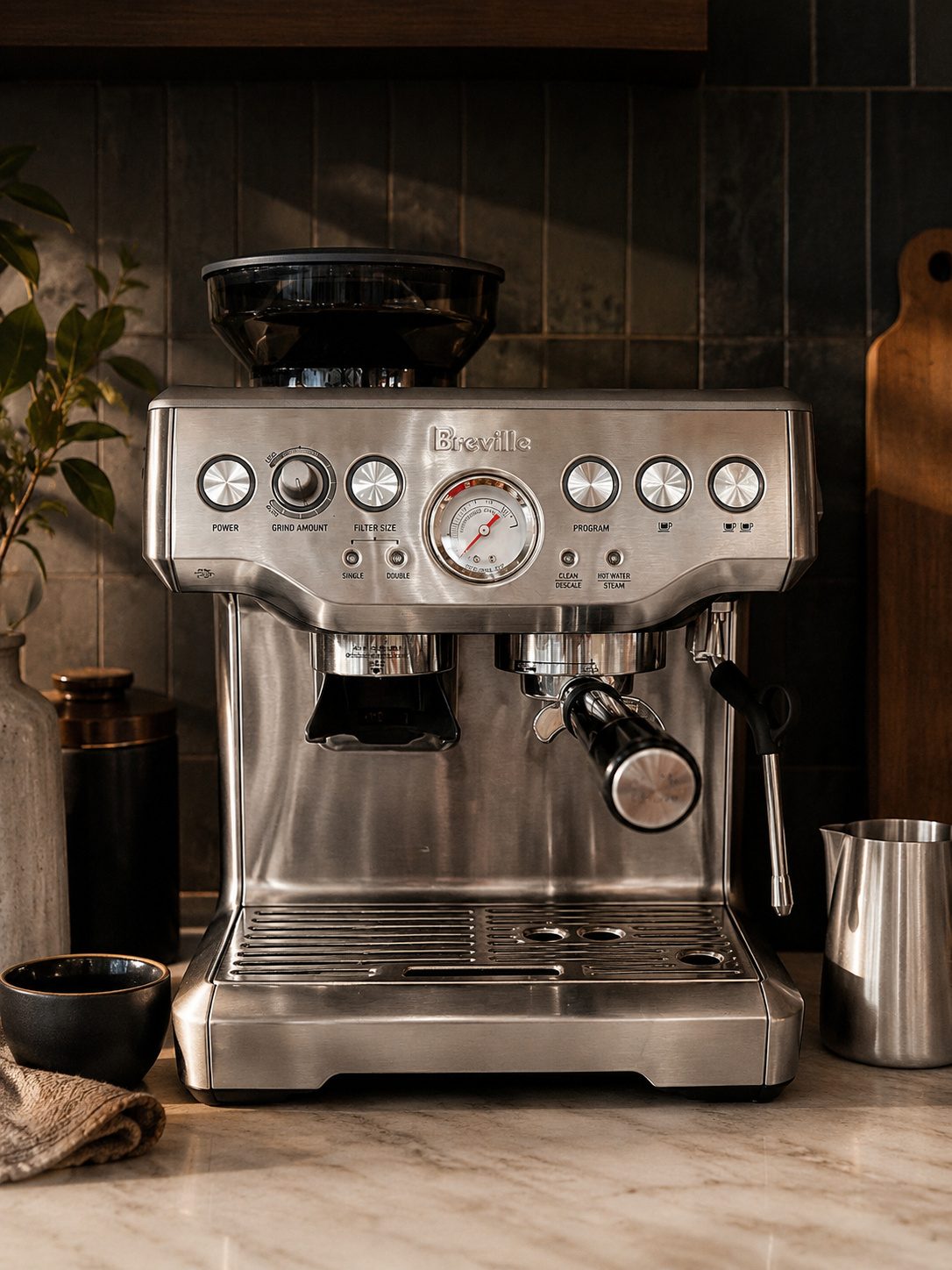
You have probably seen it on Amazon, in Williams Sonoma, or recommended on every beginner espresso thread: the Breville Barista Express, sitting there looking like the complete home espresso answer in one brushed stainless box. Built-in grinder, pressure gauge, steam wand, manual controls — it looks like everything you need. And for a lot of people, it is.
But the HomeCoffeeStack view is a little more specific: the Breville Barista Express is a strong beginner espresso system when bought at the right price, and a frustrating purchase when bought at the wrong one. The built-in grinder is simultaneously its greatest convenience and its most real limitation. That tension is worth understanding before you spend $600 or more.
This review is based on product research, owner feedback, manufacturer specifications, and HomeCoffeeStack system analysis. See our review methodology for how we evaluate espresso equipment.
Quick Verdict: Who Should Buy the Breville Barista Express?
Verdict: A capable, convenient all-in-one beginner espresso system — best when bought on sale. The grinder works and is good enough to learn on, but it is the part most likely to limit you as your skills grow.
Best for: Beginners who want one machine, one grinder, and one learning path without managing separate components.
Not for: People who already know they want a serious standalone grinder, or who want push-button automation.
Ideal budget: Around $650–$950 total setup cost (machine plus accessories). Verify current machine price before buying — it frequently goes on sale.
Skill level: Beginner to early enthusiast. This machine rewards effort; it does not replace it.
Coffee Stack note: The Barista Express covers the machine and grinder layers of your stack. You still need fresh beans, a scale, puck prep tools, and a cleaning routine to get good results.
| Reader Type | Recommendation | Why |
|---|---|---|
| First-time espresso learner | Good fit | All-in-one system reduces decision fatigue; pressure gauge helps you learn |
| Milk drink household (lattes, cappuccinos) | Good fit | Manual steam wand is capable; milk drinks are forgiving of grinder limits |
| Straight espresso enthusiast | Caution | Shot clarity and consistency depend heavily on the integrated grinder |
| Already owns a good grinder | Skip it | You are paying for a grinder you do not need; consider Bambino Plus instead |
| Wants push-button automation | Skip it | Look at Barista Express Impress or a super-automatic machine |
| Limited counter space | Good fit | One footprint for machine and grinder is a real advantage in small kitchens |
What the Breville Barista Express Is in the Coffee Stack
The Barista Express occupies two layers of your Coffee Stack at once: it is the machine and the grinder. That is the core of its appeal. Instead of researching and buying a separate espresso grinder, learning how to pair it, and finding counter space for two appliances, you get one unit that handles both jobs.
What it does not include — and what most beginners underestimate — is everything else the stack needs: fresh beans, a scale, puck prep discipline, a cleaning routine, and time to dial in. The Barista Express is not an appliance you plug in and produce good espresso from on day one without effort. It is a learning machine that rewards attention to dose, grind, tamp, and yield.
Think of it as a starter espresso stack with two layers pre-solved and three or four layers still requiring your attention. That framing sets realistic expectations and helps you budget for the full setup, not just the machine.
Breville Barista Express Specs That Actually Matter
Verify all specs against the current Breville product page before purchasing, as specifications can change between model revisions.
| Feature | Detail | Why It Matters |
|---|---|---|
| Model | BES870XL (verify current model designation) | Confirm you are buying the current revision |
| Machine type | Semi-automatic espresso machine with integrated grinder | You control dose, grind, tamp, and extraction start/stop |
| Portafilter size | 54mm | Smaller than commercial 58mm; dedicated accessory ecosystem |
| Heating system | Thermocoil with PID temperature control | PID keeps brew temperature stable; Thermocoil heats faster than boiler-only systems |
| Pump | 15-bar rated (typical operating pressure lower, around 8–9 bar at the puck) | Rated bar is marketing; 9 bar at the puck is the target for espresso |
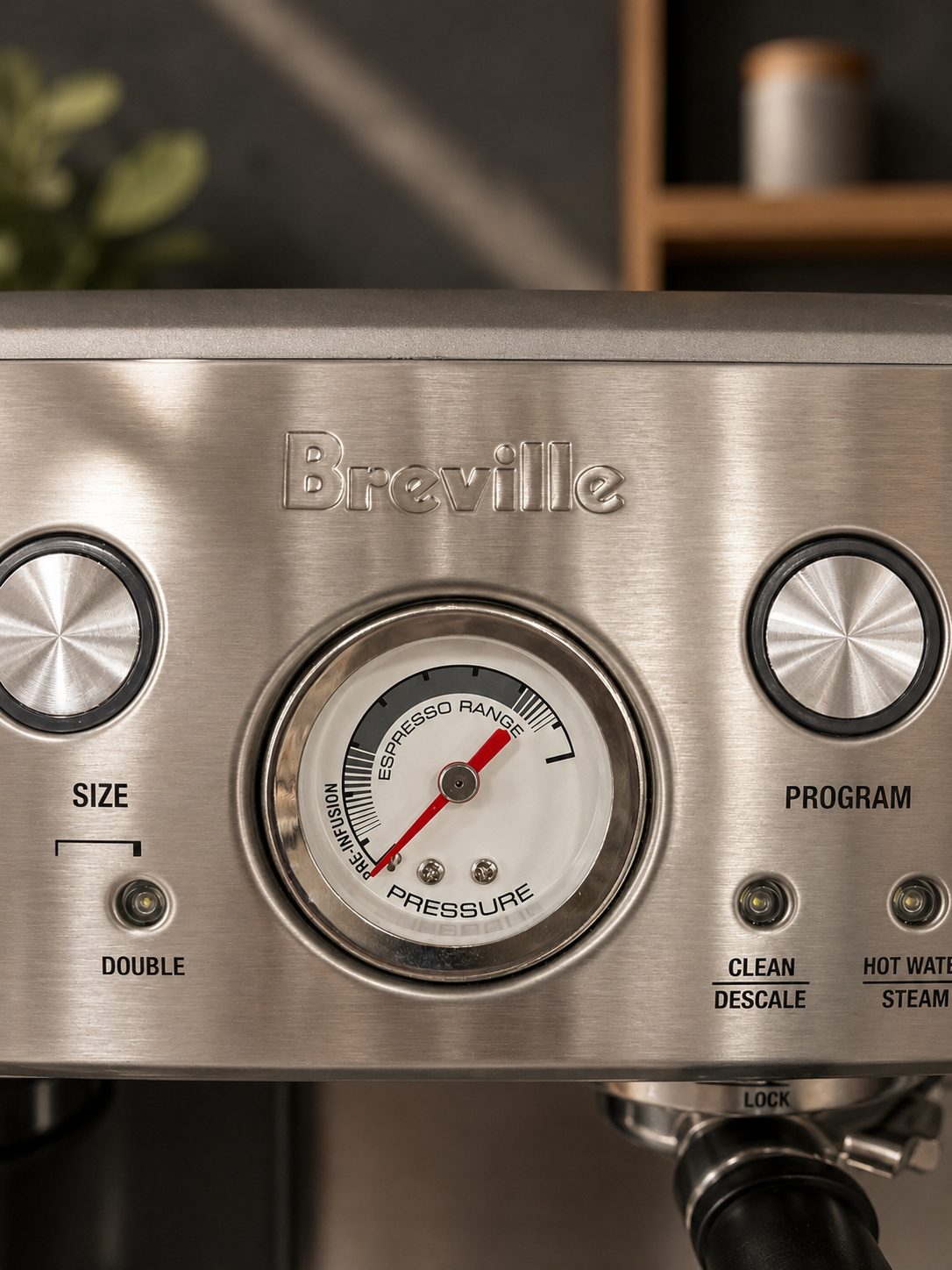
| Pressure gauge | Analog front-facing gauge | Helps beginners see extraction pressure and diagnose grind/dose issues |
| Steam wand | Manual single-hole steam wand | Capable of good microfoam with practice; not as powerful as prosumer machines |
| Integrated grinder | Conical steel burr; adjustable dose; internal and external grind size settings | The core convenience — and the core limitation |
| Water tank | Approximately 67 oz / 2 L (verify on current product page) | Large enough for daily home use without constant refilling |
| Dimensions | Approximately 13.2" H x 12.5" W x 12.7" D — verify current specs | Plan counter space; measure under cabinets for portafilter clearance |
| Approximate price | ~$599–$749 street/sale range; verify current price | Price determines whether it beats a modular stack on value |
What the Breville Barista Express Does Well
All-in-one simplicity. The most honest thing to say about the Barista Express is that it genuinely solves the "what do I buy first?" problem. One researching session, one purchase decision, one counter footprint. For a beginner who does not yet know what a DF54 or Encore ESP is, that simplicity has real value.
Manual control for real learning. Unlike super-automatics or capsule machines, the Barista Express requires you to dose, tamp, and control extraction. That friction is a feature: you learn what actually affects espresso quality. The pressure gauge gives you instant feedback on whether your grind is too coarse (low pressure, fast pour) or too fine (high pressure, slow choke). This is genuinely useful for beginners.
Milk drink performance. For lattes, cappuccinos, and flat whites, the Barista Express punches well above its price. The manual steam wand can produce decent microfoam with practice, and the grinder's limitations matter less when espresso is combined with steamed milk. If your household drinks mostly milk-based espresso drinks, this machine is a strong fit.
Ecosystem and support. The Barista Express is one of the most widely owned home espresso machines in the world. That means abundant tutorials, YouTube videos, Reddit threads, replacement parts, and accessory compatibility. When something goes wrong or when you want to improve, help is easy to find.
Resale value. Because this machine is popular and well-regarded, used examples hold value reasonably well. If you outgrow it or upgrade, you can recover a meaningful portion of your purchase price.
Where the Breville Barista Express Falls Short
The grinder is the ceiling. This is the core limitation — covered in depth in the next section — but in plain terms: the integrated grinder is usable and convenient, but it is the least capable component in the machine. As your skills improve, you will notice its limits before you notice limits elsewhere in the setup.
Workflow is slower than newer Breville models. Compared to the Barista Pro or Barista Express Impress, the original Barista Express feels dated in its workflow. Heat-up time, interface, and steam-to-brew switching are all slightly more cumbersome. Not a dealbreaker, but worth knowing if you are comparing models before buying.
Steam power is adequate, not exceptional. The steam wand will texture milk for home use, but it is not fast and not powerful by prosumer or commercial standards. If you are expecting café-speed steaming, adjust expectations. A pitcher of milk for a single latte takes more time and technique here than it would on a higher-end machine.
Dialing in takes patience. The Barista Express has two grind adjustment systems — external and internal — which gives flexibility but also creates confusion for beginners. It is not uncommon for new owners to spend several bags of beans finding settings that work. This is normal for espresso, but the machine does not make that process especially intuitive.
Maintenance is real. Backflushing, descaling, grinder cleaning, and group head cleaning are all part of owning this machine. Neglecting maintenance is one of the most commonly reported causes of deteriorating performance and eventual hardware issues. Budget time and cleaning supplies into your ownership plan.
The Built-In Grinder: Good Enough or the Weak Link?
This is the question HomeCoffeeStack takes most seriously, because the grinder matters more than any other variable in espresso quality — and the Barista Express locks the grinder into the machine.
The integrated conical burr grinder has a practical adjustment range with both coarse external settings and finer internal adjustments. It can produce grounds fine enough for espresso and coarse enough for other brew methods. For most beginners making espresso at home, especially with fresh beans and milk-based drinks, it is genuinely good enough to produce enjoyable results.
Where it shows its limits:
- Retention and clumping. Some dose is retained between shots in the grinder path, and grounds can clump without a WDT tool. This is manageable but contributes to shot-to-shot inconsistency.
- Grind-size adjustment resolution. The steps between grind settings are coarser than on a dedicated single-dose grinder. Fine-tuning for a specific bean or roast level takes patience and sometimes feels imprecise.
- Future upgrade path. If you want a better grinder later, you cannot just swap it in — you would need a separate grinder while the built-in one sits idle. The Barista Express does include a pre-ground bypass chute, but that is a workaround, not a solution.
The honest verdict on the grinder: it is convenient, it is usable, and it will limit you — all three are true simultaneously. If you know from day one that grinder quality is your top priority, a Bambino Plus paired with a dedicated espresso grinder is the smarter long-term stack. If convenience and simplicity matter more right now, the integrated grinder is a reasonable trade-off.
Espresso Quality: What to Expect in Real Use
With fresh beans, proper dialing-in, a scale, and a WDT tool, the Breville Barista Express can produce genuinely good home espresso. Not automatically, and not immediately — but with a few weeks of practice and a few bags of fresh beans, most users reach a point where their home shots rival or exceed what they were buying at a local café.
The variables that matter most:
- Bean freshness is non-negotiable. Stale supermarket beans produce flat, sour, or bitter espresso regardless of machine or technique. Fresh beans from a specialty roaster, ideally 5–20 days off roast, make an enormous difference.
- Dose and yield tracking requires a scale. Without weighing your dose in and yield out, you are guessing. A 0.1g scale is the single highest-impact accessory purchase after the machine itself.
- Puck prep consistency. A WDT tool and dosing funnel reduce channeling caused by uneven grounds distribution. These are inexpensive and meaningfully improve shot consistency.
Straight espresso drinkers will notice the grinder's limits sooner than milk drink drinkers. For a household making cortados or straight shots, a dedicated grinder stack may be worth the extra investment from the start. For a household making lattes and cappuccinos, the Barista Express hits a very sweet spot.
Milk Steaming and Latte Workflow
The Barista Express uses a manual Panarello-style steam wand that can be used with or without the rubber sleeve for different steaming techniques. Learning to use it well takes practice — this is not an automatic steam system — but most users can produce good microfoam for lattes and cappuccinos within a few weeks.
Practical expectations: a single pitcher of milk for a latte takes roughly 30–45 seconds of active steaming once you are comfortable with the technique. That is slower than machines with more powerful boilers or dedicated steam boilers, but perfectly workable for home use. If you are making drinks for two or three people in sequence, the sequential heat-up time between steam and brew modes adds a few minutes to your total workflow.
For beginners learning to steam, the manual wand is actually an advantage: it builds real skill rather than hiding the process behind automation. The Bambino Plus' automatic steam is faster and more consistent, but it teaches you less.
Breville Barista Express vs Alternatives
Prices below are approximate ranges based on typical street and sale pricing — verify all current prices before purchasing, as Breville products go on sale frequently.
| Setup | Approx. Price | Grinder Situation | Best For | Main Drawback |
|---|---|---|---|---|
| Breville Barista Express | ~$599–$749 (verify) | Integrated conical burr; convenient but limiting | Beginners wanting all-in-one simplicity | Grinder upgrade path is locked in |
| Breville Barista Pro | ~$699–$849 (verify) | Integrated flat burr; faster workflow, LCD interface | Breville fans wanting more modern features | Still integrated grinder; costs more |
| Breville Barista Express Impress | ~$749–$899 (verify) | Integrated grinder with assisted tamping and dosing | Beginners who want puck-prep help | Higher price; still integrated grinder |
| Breville Bambino Plus + Baratza Encore ESP | ~$549 + ~$199 = ~$748 (verify both) | Separate dedicated espresso grinder — upgradeable | Beginners who want grinder flexibility and faster heat-up | Two devices; more decisions upfront |
| Breville Bambino + DF54 | ~$349 + ~$189 = ~$538 (verify both) | Separate single-dose grinder; strong value | Budget-conscious beginners who want good grind quality | Bambino lacks some features of Bambino Plus |
| Gaggia Classic Pro/Evo + grinder | ~$449–$599 + grinder (verify) | Separate grinder required; commercial-group-head learning machine | Enthusiasts willing to learn more manual workflow | Steeper learning curve; fewer guardrails |
The key decision tree: if you value convenience and simplicity, the Barista Express wins. If you value grinder quality and upgrade flexibility, a Bambino Plus or Bambino plus a dedicated grinder is the smarter stack. If you want more Breville polish and a modern interface, compare the Barista Pro or Barista Express Impress at current pricing.
Use the HomeCoffeeStack Stack Builder to compare total setup costs side by side based on your budget and priorities.
What Accessories and Beans You Actually Need
The Barista Express covers the machine and grinder layers of your stack. Here is what you still need to build a complete, functional espresso setup:
| Stack Layer | Recommended Item | Why It Matters | Approx. Cost |
|---|---|---|---|
| Machine + Grinder | Breville Barista Express | Core of the stack; covers two layers at once | ~$599–$749 (verify current price) |
| Beans | Fresh specialty espresso roast, 5–20 days off roast | Bean freshness is the single biggest variable in espresso quality | ~$15–$25/bag ongoing |
| Scale | Any 0.1g espresso scale (e.g., Acaia Pearl, Timemore Black Mirror Basic, or budget alternatives) | Tracks dose in and yield out; essential for consistency | ~$15–$80 (verify) |
| WDT tool | Any needle-style WDT tool (many options on Amazon) | Breaks up clumps and evens grounds distribution before tamping | ~$10–$30 (verify) |
| Dosing funnel | 54mm dosing funnel (fits Barista Express portafilter) | Reduces mess and keeps grounds in the basket during WDT | ~$10–$25 (verify) |
| Knock box | Any sturdy knock box sized for your counter | Makes puck disposal clean and fast | ~$20–$40 (verify) |
| Cleaning supplies | Breville cleaning tablets, descaler, and group head brush | Regular maintenance protects the machine and shot quality | ~$20–$50 starter kit (verify) |
| Water filtration | Breville water filter (fits tank) or filtered water source | Water quality affects taste and scale buildup; extends machine life | ~$15–$30 for replacement filters (verify) |
Realistic first-month total: roughly $650–$950 depending on the machine sale price and which accessories you prioritize. See our beginner espresso setup guide for a fuller breakdown.
Who Should Skip the Barista Express?
The Barista Express is a good machine, but it is not the right machine for everyone. Skip it if:
- You already own a quality espresso grinder. Do not pay for a second grinder you do not need. A Breville Bambino or Bambino Plus paired with your existing grinder is the smarter buy.
- You care deeply about grinder quality and shot consistency from day one. The integrated grinder is the ceiling here. A dedicated grinder stack — even at a similar total price — gives you a meaningfully better grinding foundation.
- You want a clear long-term upgrade path. When you outgrow the integrated grinder, your options are limited. A modular machine-plus-grinder stack lets you upgrade one piece at a time.
- You want push-button automation. The Barista Express requires manual grinding, dosing, tamping, and extraction control. It is not a one-touch machine.
- You are buying at full price above $700 and the Barista Pro or Barista Express Impress is close in price. Verify current pricing: at certain sale configurations, the newer models close the gap considerably.
- You expect café-quality espresso with zero learning curve. No home espresso machine delivers that. But the Barista Express especially rewards patience — it will frustrate users who expect instant results.
If one or more of these applies, visit our beginner espresso grinder guide and best espresso machines for beginners to find a better-matched stack.
Common Mistakes Barista Express Owners Make
- Using stale supermarket beans and wondering why shots taste bad.
- Skipping the scale and guessing on dose and yield.
- Relying on the machine alone without WDT or dosing funnel, then blaming the machine for inconsistency.
- Buying the machine at full MSRP without checking whether a modular stack or the Barista Pro is a better value at current pricing.
- Expecting the steam wand to perform like a commercial machine without any learning time.
- Neglecting cleaning and descaling, leading to deteriorating pressure and flavor.
- Adjusting too many variables at once when dialing in — change one thing (usually grind size) at a time.
Final Verdict: Is the Breville Barista Express Worth It?
Yes — with conditions.
The Breville Barista Express is a genuinely good beginner espresso system. It covers two of the most important Coffee Stack layers in one box, it teaches you real espresso skills, it supports milk drink households beautifully, and it comes with a massive support ecosystem of tutorials, parts, and accessories. For a beginner who wants to start making espresso at home without navigating separate machine and grinder research, it is one of the most rational starting points available.
The conditions: buy it at the right price (around $550–$650 on sale is a strong buy; above $700 warrants comparing alternatives), buy fresh beans from day one, and add the accessory stack — at minimum a scale, WDT tool, and cleaning supplies. Budget roughly $650–$950 for a complete first-month setup.
The honest caveat: the built-in grinder is convenient and usable and limiting — all three simultaneously. It will not stop you from making excellent lattes or solid home espresso. But it will be the first thing you want to improve once your skills grow past beginner level, and you cannot simply swap it out.
If you value convenience, counter simplicity, and learning in one box, the Breville Barista Express is the right starting point. If you value grinder quality and upgrade flexibility above all else, build a modular stack from the beginning.
Ready to compare your options? Use the HomeCoffeeStack Stack Builder to find the right machine and grinder combination for your budget, space, and skill level. Or explore the full espresso machine hub to compare every beginner option side by side.
FAQ
Is the Breville Barista Express worth it?
Yes, for beginners who want an all-in-one espresso setup, especially at a sale price around $550–$650. It is less ideal if you want a better standalone grinder or a clear long-term upgrade path. At full price above $700, compare it carefully against the Barista Pro or a Bambino Plus plus separate grinder combination. Always verify current pricing before purchasing.
Is the Breville Barista Express good for beginners?
Yes, but it is not automatic. Beginners still need to learn grind size, dose, yield, tamping, and milk steaming. The machine provides a pressure gauge and enough manual control to build real espresso skills — it rewards patience and practice rather than plug-and-play use. See our guide on how to dial in espresso for where to start.
Is the built-in grinder on the Barista Express good enough?
Good enough to learn espresso and make enjoyable drinks, especially milk-based drinks. The conical burr grinder is the main limitation for shot-to-shot consistency, grind-size precision, and future growth. It performs well with fresh beans and becomes frustrating with stale supermarket coffee. For dedicated straight espresso drinkers, a separate grinder stack is worth considering.
Can the Breville Barista Express make café-quality espresso?
It can make very good home espresso with fresh beans and careful dialing-in. Results depend heavily on grinder settings, bean freshness, puck prep, and user skill. Calling it automatically café-quality would be misleading — but with practice, the shots can be genuinely excellent and better than many local cafés.
What accessories do I need for the Breville Barista Express?
At minimum: fresh espresso beans, a 0.1g espresso scale, and cleaning tablets. Strongly recommended additions are a WDT tool, a 54mm dosing funnel, and a knock box. These items add roughly $60–$140 to your total setup cost but make a meaningful difference in puck prep consistency and daily workflow.
Should I buy the Barista Express or a Bambino Plus with a separate grinder?
Choose the Barista Express for all-in-one convenience and a simpler starting point. Choose the Bambino Plus plus a separate grinder — like the Baratza Encore ESP or DF54 — if you care more about grinder quality and future upgrade flexibility. Total costs can be similar, so the choice comes down to convenience versus modularity. Use the Stack Builder to compare your specific budget.
What is the difference between the Barista Express and the Barista Pro?
The Barista Pro generally offers a faster heat-up time, a more modern LCD interface, and a slightly more refined workflow. Both use integrated grinders. The Pro typically costs more — verify current pricing before deciding whether the workflow improvements justify the premium. See our Barista Pro review for a detailed comparison.
Is the Barista Express good for lattes and cappuccinos?
Yes. The manual steam wand can texture milk well with practice and is well-suited for lattes, cappuccinos, and flat whites at home. It is not as fast or powerful as higher-end machines, but for a home setup it performs solidly. Expect a short learning curve for microfoam technique — most people find their rhythm within a few weeks.
Can I use pre-ground coffee in the Barista Express?
Yes, there is a bypass doser chute designed for pre-ground coffee. However, freshly ground beans are strongly recommended for best espresso results. Pre-ground coffee degrades quickly and makes dialing in much harder. The built-in grinder is one of the machine's main selling points — use fresh beans and grind them fresh for every shot.
How much does a full Breville Barista Express setup cost realistically?
The machine typically runs around $550–$750 depending on sales — verify current pricing before buying. Adding a scale, WDT tool, dosing funnel, knock box, and starter cleaning supplies brings your realistic first-month total to roughly $650–$950. Factor in fresh beans at $15–$25 per bag as an ongoing cost. See our beginner espresso setup guide for a full cost breakdown.