 By Jared White
The best espresso machine for latte art for most home baristas is the Breville Bambino Plus paired with a real espresso grinder like the Baratza Encore ESP or DF54. If you want to grow into manual steaming and a 58mm workflow, the Gaggia Classic Pro E24, Rancilio Silvia, Profitec GO, and Ascaso Steel DUO-style machines are better long-term learning platforms — but only if your grinder and workflow match the machine. This guide maps every pick to its full stack, shows you the real total cost, and tells you honestly when to skip each one.
Quick Verdict: Best Espresso Machine for Latte Art by Budget
If you are short on time, here is the summary. Each pick is explained in detail below.
| Pick | Best For | Skill Level | Machine Price | Grinder Needed | Milk Workflow | Skip If |
|---|---|---|---|---|---|---|
| Breville Bambino Plus | Most beginners | Beginner | ~$499* | Yes — Encore ESP or DF54 | Auto + manual steam | You want a 58mm ecosystem or heavy build |
| Gaggia Classic Pro E24 | Budget manual learners | Beginner–Intermediate | ~$499–$549* | Yes — DF54 or Encore ESP | Manual steam only | You want push-button milk |
| Rancilio Silvia | Durable manual practice | Intermediate | ~$995* | Yes — Eureka Mignon Silenzio 55 | Manual steam only | Multiple back-to-back lattes daily |
| Profitec GO | Espresso-first enthusiast | Intermediate–Advanced | ~$1,199* | Yes — Eureka Mignon Silenzio / Specialita | Manual steam, PID control | Latte art is the main daily event |
| Ascaso Steel DUO PLUS PID | Premium compact workflow | Advanced | ~$2,415* | Yes — Eureka Mignon Specialita or DF64-class | Simultaneous brew + steam | No 20-amp circuit; strict budget |
| Breville Barista Touch Impress | Family automation | Beginner | ~$1,499* | Built-in (ceiling applies) | Auto MilQ, alternative milks | You want manual control as the hobby |
| Breville Barista Express Impress | All-in-one under $1,000 | Beginner | ~$799* | Built-in (ceiling applies) | Manual steam wand | You plan to upgrade the grinder later |
*Prices checked June 13, 2026 — verify current price before purchasing.
Build your full latte-art stack in the Coffee Stack Builder →
What Actually Makes a Machine Good for Latte Art?
Most buying guides rank espresso machines by feature count. That misses the point. Latte art needs three things to work together: a stable, textured espresso shot with real crema; milk steamed to glossy, paint-like microfoam; and a workflow that gives you both at the right time. Here is what actually separates good latte-art machines from bad ones.
- Steam wand control. A steam wand you can angle, reposition, and feather matters more than raw steam pressure. Big-bubble steam that over-aerates milk in two seconds is the enemy of microfoam. Look for a wand you can move freely and a boiler or thermoblock that sustains pressure through a full 6–8 oz pitcher.
- Shot consistency. Latte art poured over a thin, sour, or channeled shot looks bad and tastes worse. Pressure stability, temperature consistency, and a good basket all matter — and none of them work without a capable grinder feeding the portafilter.
- Workflow clearance. Single-boiler machines require you to pull the shot, then purge and wait before steaming. Dual-thermoblock or heat-exchanger machines let you do both simultaneously. Neither prevents latte art, but the timing difference affects your practice pace.
- Cup clearance and portafilter fit. A machine with a low drip tray and enough clearance for a 6–8 oz latte glass makes the pour easier to practice.
- Grinder pairing. This is the most underrated factor. A machine with perfect pressure stability but a cheap grinder will produce inconsistent pucks, and inconsistent pucks produce inconsistent crema. The grinder determines the quality of the espresso base more than any other single variable.
The Coffee Stack Rule: Do Not Buy the Machine Without the Grinder
Here is the most important thing in this guide: machine price is not setup price, and the grinder matters more than the machine. A $500 espresso machine paired with a $200–$250 burr grinder like the Baratza Encore ESP or DF54 will reliably outperform a $1,000 machine fed by a blade grinder or a supermarket pre-ground bag. Every recommendation below includes a grinder pairing because every recommendation is incomplete without one.
The Coffee Stack model at HomeCoffeeStack treats coffee as a system: machine + grinder + beans + milk workflow + accessories + practice. Latte art is the product of the whole stack, not any single component. If your budget is $800 total, put $499 toward a Bambino Plus and $200–$250 toward a real espresso grinder before buying any accessories. If your budget is $1,500, the Rancilio Silvia and a capable grinder is a more rewarding long-term investment than a $1,500 all-in-one with a grinder you cannot upgrade.
See our full guide to the best espresso grinders →
| Budget Tier | Machine | Grinder Pairing | Accessories Est. | Approx. Setup Cost | Best User |
|---|---|---|---|---|---|
| Entry (~$750–$900) | Breville Bambino Plus (~$499*) | Baratza Encore ESP (~$200*) or DF54 (~$249*) | ~$80–$120 | ~$780–$870 | First latte-art setup |
| Serious Beginner (~$850–$1,100) | Gaggia Classic Pro E24 (~$499–$549*) | DF54 or Encore ESP (~$200–$249*) | ~$100–$150 | ~$850–$1,000 | Manual learner, 58mm path |
| Intermediate (~$1,600–$1,800) | Rancilio Silvia (~$995*) | Eureka Mignon Silenzio 55 (~$499*) | ~$150–$200 | ~$1,650–$1,800 | Durable manual practice |
| Enthusiast (~$1,750–$2,000) | Profitec GO (~$1,199*) | Eureka Mignon Silenzio 55 / Specialita (~$499–$599*) | ~$150–$200 | ~$1,850–$2,000 | Espresso-first, occasional lattes |
| Premium (~$3,000+) | Ascaso Steel DUO PLUS PID (~$2,415*) | Eureka Mignon Specialita or DF64-class (~$549–$650*) | ~$150–$200 | ~$3,100–$3,300 | Serious home barista |
*All prices checked June 13, 2026 — verify current price. Accessory estimates include scale, pitcher, tamper, and cleaning basics.
Milk Workflow: Automatic vs. Manual vs. Simultaneous
Before diving into individual machines, understand that "auto milk" and "manual steam" describe very different latte-art paths. Here is how the main options compare.
| Machine | Steam Type | Auto Milk? | Manual Steam Control? | Brew + Steam Simultaneously? | Best for Practicing Latte Art? |
|---|---|---|---|---|---|
| Breville Bambino Plus | Thermojet steam | Yes (auto + manual) | Yes | No (single boiler) | Good — auto helps beginners start |
| Gaggia Classic Pro E24 | Brass boiler steam | No | Yes | No (single boiler) | Very good — real learning platform |
| Rancilio Silvia | Brass boiler steam | No | Yes — full-motion wand | No (single boiler) | Excellent — strong, controllable steam |
| Profitec GO | Brass boiler, PID | No | Yes | No (single boiler) | Excellent — PID adds consistency |
| Ascaso Steel DUO PLUS PID | Dual thermoblock | No | Yes | Yes | Excellent — best workflow of the group |
| Barista Express Impress | Thermocoil steam | No | Yes | No (single boiler) | Good — convenient assisted workflow |
| Barista Touch Impress | Thermocoil, Auto MilQ | Yes (Auto MilQ) | Limited | No (single boiler) | Decent for easy milk drinks |
Best for Most Beginners: Breville Bambino Plus
The Bambino Plus is the machine we point most beginners to first, and the reason is straightforward: it keeps the machine cost low enough that you can still afford a real espresso grinder, it heats up in about 3 seconds, and it offers both automatic and manual milk texturing so you can use training wheels early and remove them as your technique improves. At approximately $499 (verify current price), it leaves $200–$400 in a $750–$900 total budget for a Baratza Encore ESP or DF54 — the grinder that makes the whole stack work.
The automatic milk mode textures milk to a preset temperature and texture level, which is genuinely useful when you are still learning the espresso side of the workflow. Once your shots are consistent, switch to the manual steam wand and begin learning the whirlpool, the stretch, and the pour. The 54mm portafilter is smaller than the 58mm commercial standard, but the accessory ecosystem for 54mm Breville machines is well-developed and the size difference does not affect latte-art outcomes.
Pair it with: Baratza Encore ESP (~$200, verify current price) or DF54 (~$249, verify current price); a 12 oz stainless pitcher with a pointed spout; a compact scale (0.1g resolution); fresh medium-roast espresso beans.
Skip it if: you want a 58mm commercial accessory ecosystem, a heavy semi-commercial build, long-term repairability over convenience, or you plan to make four or more milk drinks back-to-back every morning.
Check the Breville Bambino Plus current price →
Best Budget Manual Learner: Gaggia Classic Pro E24
The Gaggia Classic Pro E24 is the right machine for someone who wants to learn espresso and milk steaming the way a barista does — with a proper 58mm portafilter, a real brass boiler, and a manual workflow that teaches you rather than does it for you. At approximately $499–$549 depending on retailer (verify current price), it is competitively priced against the Bambino Plus while offering a different set of strengths: a 58mm accessory ecosystem, a lead-free brass boiler, 9-bar brew pressure, and a full-size steam wand that rewards practice.
The single-boiler design means you pull your shot first, then switch to steam mode and wait a short time before texturing milk. This is a real workflow difference from the Bambino Plus, and it slows your first few weeks of practice. But it also teaches you the sequencing and timing that a serious home barista needs to understand. The Gaggia Classic platform is one of the most popular entry points into semi-automatic espresso precisely because it is a genuine learning machine, not a guided assistant.
Worth noting: Whole Latte Love describes a newer Gaggia Classic UP with added PID boiler regulation, pre-infusion cycles, a 9-bar OPV, pressure gauge, and a fully articulated commercial steam wand. If available and competitively priced at your time of purchase, it may be a better pick than the base Classic Pro E24. Verify price and availability before purchasing.
Pair it with: DF54 (~$249, verify current price) or Baratza Encore ESP (~$200, verify current price); a 58mm tamper; a 12 oz pitcher; scale; fresh beans. If budget allows, step up to the Eureka Mignon Silenzio 55 for a notable grind quality bump.
Skip it if: you want push-button milk texturing, you dislike manual espresso timing, or your household needs multiple back-to-back lattes with minimal waiting.
Check the Gaggia Classic Pro E24 current price →
Best Durable Manual Classic: Rancilio Silvia
The Rancilio Silvia has been a trusted home espresso machine for decades, and the reasons are still valid: it is built like a piece of commercial equipment, it has a full-motion stainless steel steam wand that produces genuinely excellent microfoam when you learn to use it, and it is repairable to a degree that few consumer machines can match. At approximately $995 (verify current price at Clive Coffee and other specialty retailers), it costs more than the Bambino Plus or Gaggia Classic Pro E24, but the Silvia is a machine you keep for ten or fifteen years.
The brass boiler produces strong, sustained steam that is ideal for latte art practice once you learn to control it. The 58mm portafilter fits the same baskets and accessories as full café machines. The trade-off is the single-boiler design — you brew and then steam, with a purge and short wait in between. The standard Silvia also ships without a PID, which means temperature management during the shot requires a bit of technique (a practice called temperature surfing). Many owners add an aftermarket PID, which brings the total cost up but adds real control. If that sounds like more work than you want, the Profitec GO is a better choice.
Pair it with: Eureka Mignon Silenzio 55 (~$499, verify current price); 58mm precision basket; 12–20 oz pitcher; scale; soft water solution; fresh beans.
Skip it if: you want PID control out of the box, you are making several milk drinks in a row for a family, or you prefer automation over manual skill building.
Check the Rancilio Silvia current price →
Best Single-Boiler Enthusiast Pick: Profitec GO
The Profitec GO is the machine for someone who wants genuine espresso-focused control — PID temperature regulation, a pressure gauge, an adjustable expansion valve, and a fast 5–7 minute heat-up time — in a compact, premium single-boiler package. At approximately $1,199 (verify current price at Clive Coffee), it sits above the Rancilio Silvia in price but offers meaningfully better shot-to-shot consistency thanks to the PID and pressure visibility. The 0.3L brass boiler and 2.8L tank are well-matched to a household that prioritizes espresso quality and makes occasional lattes.
The qualifier matters: "occasional lattes." If latte art is your main event every single morning — pulling one shot and steaming one pitcher after another for multiple people — a single-boiler machine will feel slow. You pull the shot, purge, steam, and repeat. For one or two drinks in a session it is a non-issue. For four drinks back-to-back it is a workflow bottleneck. The Profitec GO is at its best when paired with an excellent grinder, fresh single-origin or espresso-blend beans, and a barista who cares about the espresso as much as the milk art.
Pair it with: Eureka Mignon Silenzio 55 (~$499, verify current price) or Eureka Mignon Specialita (~$549–$599, verify current price); DF64-class grinder if budget allows; precision 58mm basket; scale; 12–20 oz pitcher; soft water.
Skip it if: latte art is the primary reason you are buying an espresso machine, or you regularly make four or more milk drinks in a single session.
Check the Profitec GO current price →
Best Premium Compact Workflow: Ascaso Steel DUO PLUS PID
The Ascaso Steel DUO PLUS PID is the premium compact choice for serious home baristas who want to pull a shot and steam milk at the same time without buying a full-size dual-boiler machine. The dual-thermoblock design — one block for brewing, one for steam — is what makes simultaneous operation possible in a relatively compact footprint. The 58mm portafilter, programmable controls, and 2,000W power output put it in a different performance category from the machines above. At approximately $2,415 (verify current price at Ascaso USA), it is a significant investment, and it comes with an important practical caveat.
The Steel DUO PLUS PID requires a NEMA 5-20 outlet and a 20-amp dedicated circuit. Many North American kitchens have 15-amp standard outlets. Before purchasing, confirm that your kitchen has or can be fitted with a compatible 20-amp circuit. Additionally, the Ascaso USA page showed this model as sold out when checked on June 13, 2026 — verify current availability before expecting immediate delivery. The thermoblock steam is excellent but has a different feel and character from the large boiler on a dual-boiler prosumer machine; both can produce great microfoam, but they are not identical experiences.
Pair it with: Eureka Mignon Specialita (~$549–$599, verify current price) or a DF64-class grinder (~$600–$650, verify current price); 58mm precision basket; 12 and 20 oz pitchers; scale; fresh beans.
Skip it if: you do not have a 20-amp circuit, the model is currently out of stock for your timeline, you are on a strict budget, or you are buying your first espresso machine and have not yet built the workflow skills to benefit from simultaneous brew and steam.
Best Assisted and Automatic Options
Breville Barista Express Impress (~$799, verify current price)
The Barista Express Impress is a strong all-in-one for beginners who want a guided puck-prep workflow and do not want to research a separate grinder. The assisted 22-lb tamping, built-in conical burr grinder with 25 grind settings, manual steam wand, and PID-controlled thermocoil make it a capable starter machine. The manual steam wand is a genuine plus for latte-art learners — you are pulling and steaming yourself, just with some help on the grinding and dosing side.
The honest caveat: the integrated grinder is both the convenience and the ceiling. If you decide in a year that you want finer grind control or a flat-burr grinder upgrade, you cannot swap the grinder without replacing the whole machine. For a household that wants a clean single-unit setup with room to practice latte art, it is a solid choice. For someone who wants a modular stack they can upgrade piece by piece, a Bambino Plus plus a separate grinder is more flexible.
Check the Breville Barista Express Impress current price →
Breville Barista Touch Impress (~$1,499, verify current price)
The Barista Touch Impress adds Auto MilQ automatic milk texturing, alternative milk settings (dairy, almond, oat, soy), a touchscreen with drink guidance, 30 grind settings, and a milk temperature range of 104°F–167°F with eight texture levels. For a household that wants consistently good café-style drinks without much manual involvement — especially with non-dairy milks — this is the most convenient machine on the list.
What it is not is a manual-latte-art learning machine. Auto MilQ textures the milk for you, which means you are not developing the steam technique that translates to pouring controlled microfoam from a pitcher. The drinks will look and taste good, but the learning curve for traditional latte art still exists on the pour side. If that trade-off fits your household, it is a genuinely excellent machine. If the skill-building is the point for you, the Gaggia Classic Pro E24 or Rancilio Silvia will teach you more.
Check the Breville Barista Touch Impress current price →
Latte Art Setup Cost Calculator
Use this tool to estimate your full latte-art stack cost before you commit to a machine. Enter the machine and grinder prices from your current research, plus accessory and monthly bean estimates.
What to Pair With Each Machine
Every machine recommendation is incomplete without its stack. Here is the full pairing guide.
| Machine | Grinder Pairing | Pitcher | Scale | Key Accessories |
|---|---|---|---|---|
| Breville Bambino Plus | Baratza Encore ESP (~$200*) or DF54 (~$249*) | 12 oz pointed-spout | Compact 0.1g scale | 54mm dosing funnel, cleaning tablets, fresh medium-roast beans |
| Gaggia Classic Pro E24 | DF54 (~$249*) or Baratza Encore ESP (~$200*); upgrade to Eureka Mignon Silenzio 55 (~$499*) when ready | 12 oz pointed-spout | 0.1g scale | 58mm tamper, bottomless portafilter, fresh beans |
| Rancilio Silvia | Eureka Mignon Silenzio 55 (~$499*) | 12–20 oz | 0.1g scale | 58mm precision basket, knock box, water test strips, cleaning kit |
| Profitec GO | Eureka Mignon Silenzio 55 (~$499*) or Specialita (~$549–$599*) | 12–20 oz | 0.1g scale | 58mm precision basket, soft water solution, knock box |
| Ascaso Steel DUO PLUS PID | Eureka Mignon Specialita (~$549–$599*) or DF64-class (~$600–$650*) | 12 and 20 oz | 0.1g scale | 58mm precision basket, both pitcher sizes, water filtration |
| Barista Express Impress | Built-in (upgrade path limited) | 12 oz | Compact 0.1g scale | 54mm accessories, cleaning tablets, fresh beans |
| Barista Touch Impress | Built-in (upgrade path limited) | 12 oz | Low-profile scale | Cleaning supplies, fresh beans, alternative milk if needed |
*Prices checked June 13, 2026 — verify current price before purchasing.
See the full espresso grinder buying guide →
Common Mistakes That Kill Latte Art
- Spending the whole budget on the machine and ignoring the grinder. This is the single most common setup mistake. A $250 grinder attached to a $500 machine will consistently outperform a $1,200 machine fed by a $50 blade grinder.
- Assuming automatic foam equals instant latte art. Auto texturing helps with consistency, but the pour — the actual design in the cup — still requires your hand, your angle, and your timing. Practice is unavoidable.
- Buying a single-boiler machine for a household that wants four lattes in a row. Single-boiler machines are excellent for one or two drinks per session. For a family of four who all want lattes every morning, the workflow bottleneck becomes a daily frustration.
- Using old supermarket beans. Stale beans produce weak, pale crema that breaks apart when milk hits it. Fresh, well-roasted espresso beans (roasted within the last two to four weeks) are not optional for latte art.
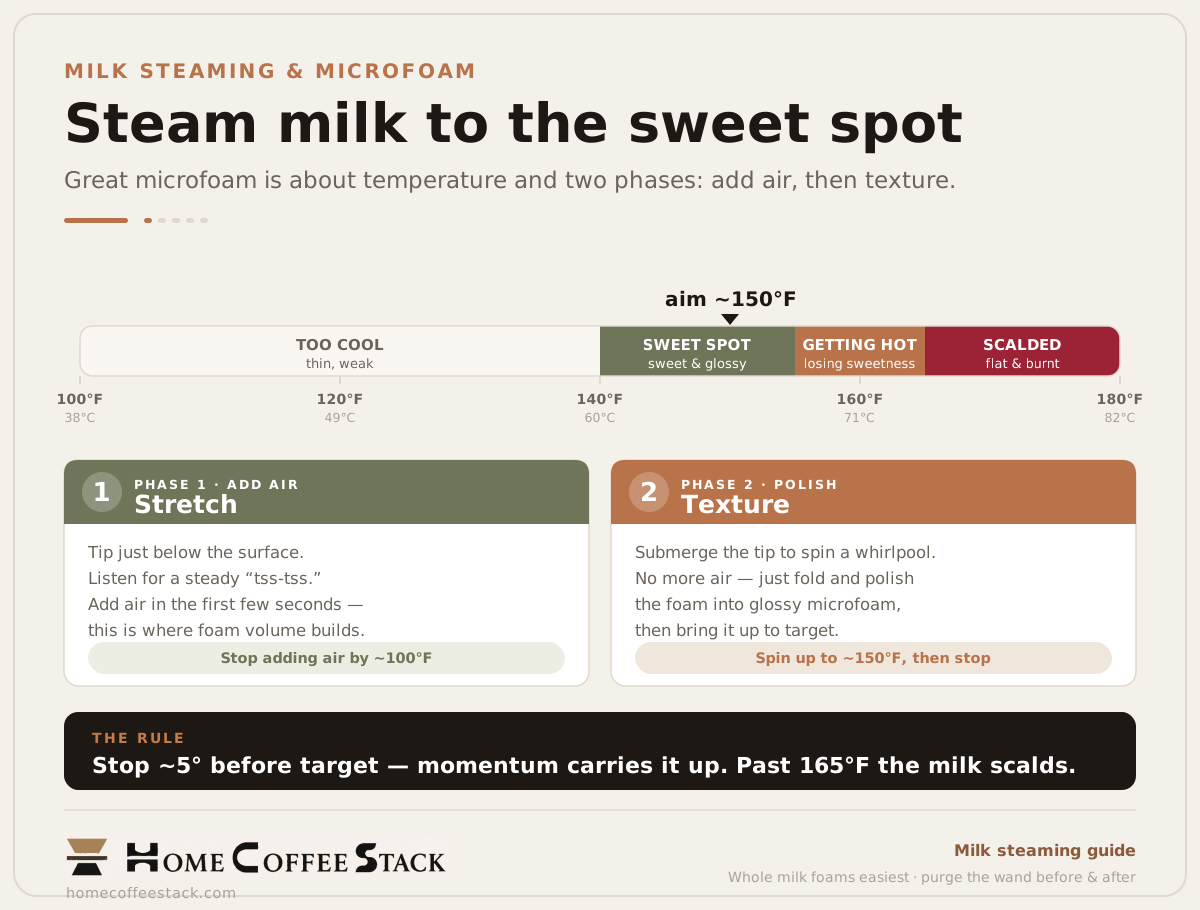
- Ignoring pitcher size, milk temperature, and cup shape. A 12 oz pitcher for a 6 oz latte, milk steamed to 140–150°F, and a wide-mouth 6–8 oz latte bowl give you the best conditions for controlled pours. Oversized pitchers, overheated milk, and narrow cups make the art harder to place.
- Waiting too long after steaming. Pour immediately after steaming. Textured milk begins to separate within 20–30 seconds. Pull your shot first in a single-boiler workflow, then steam and pour without delay.
Who Should Skip These Machines Entirely?
These machines are not for everyone. Consider skipping all of them — at least for now — if:
- You do not have budget for a separate espresso grinder and the machine. The grinder is not optional for good latte art.
- You have no interest in practicing or maintaining manual espresso workflow. A super-automatic machine or a high-quality pod machine may be a better fit for your actual lifestyle.
- You have very limited counter space. Even a compact machine plus a grinder requires a meaningful footprint. Measure before buying.
- You primarily want to make large milk drinks quickly for a large household. A commercial-grade home machine with a heat exchanger or dual boiler — and the budget to match — is a better long-term fit.
- You are unwilling to descale, backflush, and maintain the machine. All espresso machines require regular cleaning. Skipping maintenance leads to bad shots, bad milk, and shorter machine life.
FAQ
What is the best espresso machine for latte art at home?
For most beginners, the Breville Bambino Plus paired with a real espresso grinder is the best starting point. It heats up in about 3 seconds, offers both automatic and manual milk texturing, and leaves enough budget for a Baratza Encore ESP or DF54. If you want a 58mm manual learning platform, the Gaggia Classic Pro E24, Rancilio Silvia, Profitec GO, and Ascaso Steel DUO PLUS PID are better long-term options by budget.
Do I need a good grinder for latte art?
Yes. Latte art starts with a stable espresso shot and real crema. A consistent espresso grinder is what makes that possible. A blade grinder or wrong burr type will produce sour, thin, or channeled shots that no milk technique can fix. The grinder is the most impactful single upgrade in any espresso stack.
Is the Breville Bambino Plus good for latte art?
Yes, especially for beginners. The automatic and manual milk texturing modes let you learn incrementally, and the fast heat-up keeps the workflow practical. Pair it with an espresso grinder, a 12 oz pointed-spout pitcher, and fresh beans, and it is a genuinely capable latte-art starter machine.
Is automatic milk frothing good enough for latte art?
Automatic texturing produces smoother, more consistent milk than most beginners can achieve manually at first. But pouring latte art — placing a heart, rosetta, or tulip — still requires your hand technique, pitcher angle, and pour timing. Manual steam control is the better teacher for developing real latte-art skill.
Can a single-boiler espresso machine make latte art?
Yes. Machines like the Gaggia Classic Pro E24, Rancilio Silvia, and Profitec GO produce excellent latte art. You brew first, then switch to steam mode, purge briefly, and steam the milk. This adds a minute to each drink but does not prevent quality microfoam or good pours once you learn the sequencing.
What is the cheapest setup that can make latte art?
A realistic entry setup is a Breville Bambino Plus (~$499, verify current price) or Gaggia Classic Pro E24 (~$499–$549, verify current price) plus an espresso-capable grinder, scale, 12 oz pitcher, and fresh beans. Budget roughly $750–$1,000 total depending on deals and grinder choice.
Is a 58mm portafilter better for latte art?
Not automatically. A 58mm portafilter opens a larger accessory ecosystem and mirrors café workflow, but milk texture and grinder quality matter far more than portafilter size. A well-run 54mm machine with an excellent grinder will produce better latte art than a neglected 58mm setup.
What milk pitcher size is best for latte art at home?
A 12 oz pitcher is the best starting size for a single 6–8 oz latte or cappuccino. A 20 oz pitcher helps for larger drinks or steaming for two people. Look for a pointed spout — it gives you the control needed for detailed free-pour designs as your technique develops.
Why does my milk not pour latte art?
The most common causes are over-aeration (too much foam, big bubbles), overheated milk, no rolling whirlpool during steaming, a weak espresso base from stale beans or a poor grinder, the wrong cup shape, or waiting too long after steaming before pouring. Start by fixing the espresso and milk texture before worrying about pour technique.
Is the Barista Express Impress good for latte art?
Yes, for beginners who want an assisted all-in-one workflow. The manual steam wand is real and teachable. The honest limitation is that the built-in grinder becomes the ceiling — you cannot upgrade just the grinder later. A Bambino Plus plus a separate grinder is a more flexible stack if you plan to grow.
Final Verdict: Build the Stack, Not Just the Machine
The best espresso machine for latte art is the one that fits your budget, your skill level, and — critically — leaves enough in the budget for a real espresso grinder. For most beginners, that is the Breville Bambino Plus plus a Baratza Encore ESP or DF54. For hands-on learners who want to grow into a café-quality workflow, the Gaggia Classic Pro E24 and Rancilio Silvia are the most rewarding platforms at their price points. For enthusiasts who want precise single-boiler control, the Profitec GO is the clearest step up. For serious home baristas who want simultaneous brew and steam in a compact footprint, the Ascaso Steel DUO PLUS PID — availability and circuit requirements permitting — is the premium compact choice.
In every case, the grinder matters more than the machine. Buy the stack, not just the hardware. Use fresh beans. Practice the pour. The art follows the system.
Build your personalized latte-art stack in the Coffee Stack Builder →
Explore the full Espresso hub → | Best espresso grinders → | Best beans for espresso →