 By Jared White · Home Barista & Systems Thinker
A home coffee system is five layers that have to work together: grind, brew, beans, workflow, and space. The quality of your coffee is set by the weakest layer — not the most expensive one. A balanced $300 system beats an unbalanced $1,500 one almost every time. Stop shopping for products; start building a system.
Why "what's the best coffee machine?" is the wrong question
Walk into any conversation about home coffee and you'll hear the same question: "What's the best espresso machine?" or "Which coffee maker should I buy?" It feels like the right question. It's not.
Here's the problem. You can buy a $1,500 espresso machine, pair it with a $40 blade grinder and a bag of beans that's been sitting on a grocery shelf for four months, and you will make worse coffee than someone with a $200 setup who got the system right. The machine isn't what makes the coffee good. The system is.
Coffee is what engineers call a series system — a chain where the weakest link sets the performance of the whole. It doesn't matter how good your machine is if the grind is inconsistent. It doesn't matter how precise your grinder is if the beans are stale. Every layer caps the one above it. Understanding this single idea will save you more money and make you better coffee than any individual product recommendation ever could.
The five layers of a home coffee system
Every home coffee setup, from the simplest to the most elaborate, is built from the same five layers. Get them in balance and great coffee becomes repeatable. Neglect one and the whole system suffers.
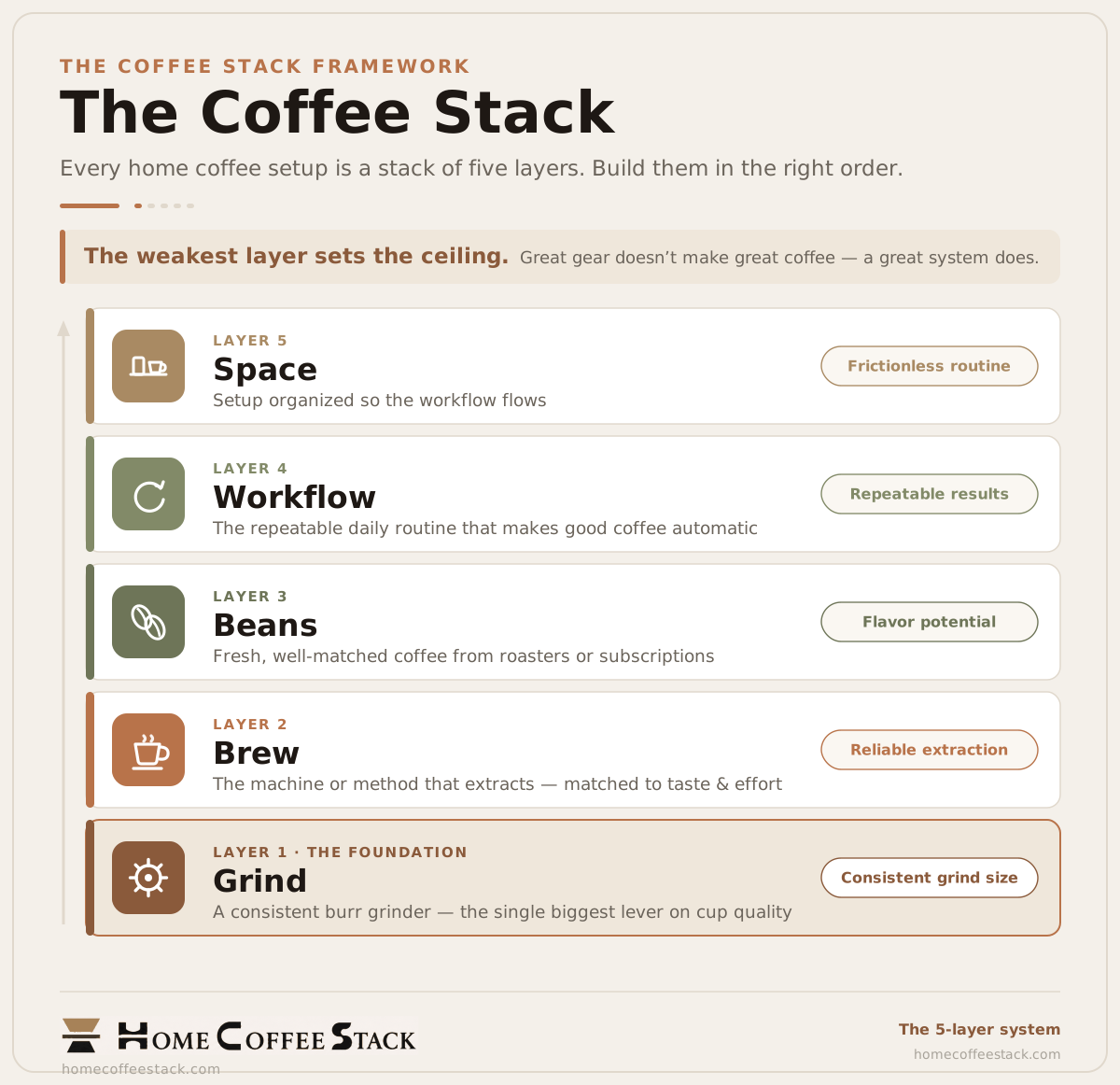
The grinder is the single most important — and most underrated — component in your coffee system. Its job is to produce coffee particles of consistent, even size. When particles are uniform, water extracts flavor evenly and the cup tastes balanced. When particles are a mix of boulders and dust (which is what cheap blade grinders produce), you get simultaneous under-extraction and over-extraction in the same cup: sour and bitter at once.
This is why experienced coffee people say "the grinder matters more than the machine," and they mean it. If you have $400 to spend on espresso, you're often better served putting $250 into the grinder and $150 into the machine than the reverse. We'll come back to this — it's the most common and most expensive mistake beginners make.
This is the layer everyone thinks about first: the espresso machine, the pour-over dripper, the French press, the AeroPress. The brewer's job is to bring water and ground coffee together under the right conditions — temperature, time, and pressure or agitation — to extract flavor.
The key insight: there's no single "best" brewer. There's the best brewer for your taste, effort tolerance, and the rest of your system. Espresso requires a much higher investment across the whole system to do well. Pour-over and AeroPress produce exceptional coffee at a fraction of the cost and complexity. Choosing the right brew method for your situation is more important than buying the most advanced one.
No system, however expensive, can make great coffee from bad beans. Freshness is the variable most beginners ignore and most enthusiasts obsess over — for good reason. Coffee is best from roughly 4 days to 4 weeks after roasting. Past that, it goes flat. The pre-ground coffee in a grocery store has often been sitting for months and was ground long ago, losing aromatics by the minute.
The single highest-impact upgrade for most people isn't equipment at all — it's switching to fresh, whole-bean coffee from a roaster or a subscription and grinding it just before brewing. This one change does more for cup quality than a several-hundred-dollar machine upgrade.
Workflow is the layer that turns equipment into coffee, every day, reliably. It's your recipe and your routine: the dose, the grind setting, the water temperature, the timing, the technique. A good workflow is repeatable — you can hit the same result tomorrow that you hit today, then adjust deliberately to improve.
This is also the layer that determines whether you'll actually use your setup. The best system is the one that fits your morning. A complex setup that takes 15 minutes and a sink full of cleanup will get abandoned for the drive-through. Designing a workflow you'll actually follow is as important as the gear itself.
The layer almost every coffee site ignores. Your physical setup — the counter, cart, shelf, or dedicated coffee bar — determines whether your workflow flows or fights you. If your grinder is in a cabinet, your beans are across the kitchen, and there's no room to work, you'll feel friction every morning. Friction kills habits.
A well-organized coffee space puts everything within reach in the order you use it, has room for the actual motions of brewing, and makes the ritual pleasant. It's the difference between a setup you tolerate and one you look forward to. This is a genuine competitive advantage of building a system: you design the space around the workflow, not the other way around.
The weakest-link principle
Here's the rule that ties the whole framework together: your coffee is only as good as the weakest layer in your system.
Imagine rating each layer from 1 to 10. A setup with a 9/10 espresso machine, a 3/10 grinder, and 4/10 stale beans doesn't produce 9/10 coffee — it produces something closer to a 4. The expensive machine is wasted potential. Meanwhile, a setup with a 6/10 brewer, a 7/10 grinder, and 8/10 fresh beans, all working together, produces genuinely satisfying coffee.
When you want to improve your coffee, don't upgrade the thing that's already good. Find your weakest layer and fix that. Most of the time, for most people, the weakest layer is the grinder or the beans — not the machine. Diagnose the system, then spend.
Why the grinder matters more than the machine
This deserves its own section because it's so counterintuitive and so important. When most people get into better coffee, they spend on the visible, exciting centerpiece: the machine. The grinder feels like an accessory. This is backwards.
The grinder determines particle consistency, and particle consistency determines extraction quality. A great machine fed inconsistent grounds will pull inconsistent shots — channeling, sour-bitter clashes, no repeatability. A modest machine fed consistent grounds from a good burr grinder will produce clean, repeatable, delicious results.
The pattern is so reliable that experienced enthusiasts will tell you: if you're choosing between upgrading your machine or your grinder, upgrade the grinder. And if you're building from scratch with a fixed budget, weight it toward the grinder more than feels natural. A quality hand grinder like the Timemore Chestnut C3 or 1Zpresso Q-Air costs $60–80 and outperforms grinders built into machines costing many times more. See our grinder guides →
Build in stages, not all at once
One more advantage of systems thinking: it tells you how to grow. You don't need the ultimate setup on day one. In fact, you shouldn't try — your taste will develop and you'll make better decisions later with experience.
The right approach is to build a complete, balanced system at your current budget, live with it, learn what you actually care about, then upgrade the weakest layer when you're ready. This is the upgrade path, and it's how you avoid buying gear you'll outgrow in six months. A $250 starter stack that's balanced is a better starting point than half of a $1,000 setup.
Where to go from here
Now that you understand the framework, the rest of the site is organized around it. If you're ready to build, start with one of these: